
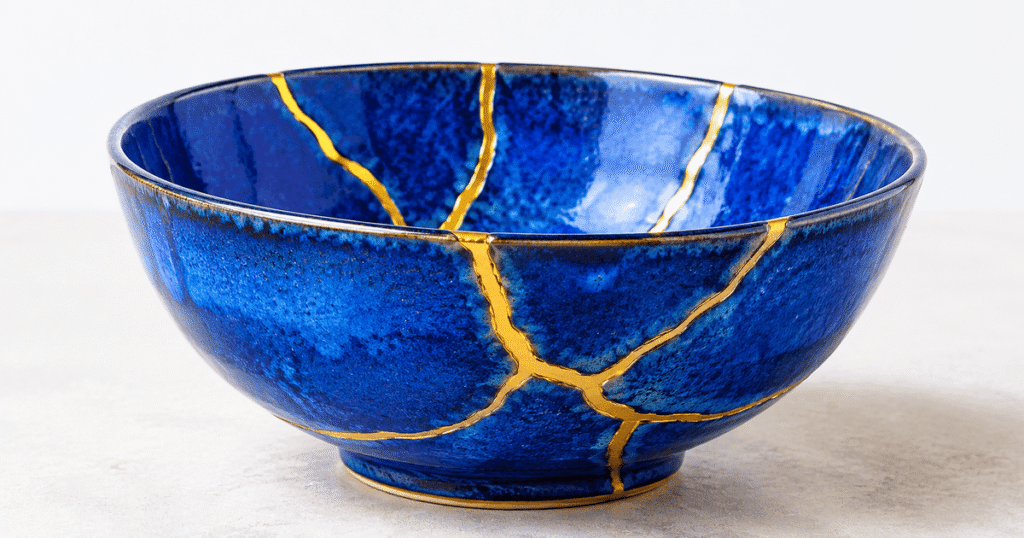
Life leaves its marks. You decide what they become.
Centuries ago in Japan, a prized ceramic bowl was broken. According to a popular account, when it was repaired with crude metal staples, its owner was dissatisfied and asked Japanese craftsmen to find a better way. Their solution was unusual. Instead of disguising the damage, they repaired the cracks with lacquer and highlighted them with gold.
The bowl was not restored to what it had been. It became something different and, in the eyes of many, more beautiful because of what had happened to it. The art became known as Kintsugi, literally “golden joinery”.
What fascinates me about Kintsugi is not simply its beauty. It challenges our instinct about what should happen after something breaks. Our natural response is restoration. We want to repair the damage, remove the evidence and return things to how they were. Kintsugi takes a different view. It does not hide the crack. It makes the crack part of the object’s continuing story.
Leadership leaves marks too. A decision that went badly. A promotion that did not come. A relationship that became difficult. A business that struggled. A role in which we discovered that strengths that had served us for years were suddenly no longer enough. Our instinct is often to move past these experiences quickly. We explain them away, hide them, or sometimes carry them much longer than we realise.
But the experience itself is only part of the story. What we make of it influences what comes next. A failure can make one leader defensive and another more thoughtful. A difficult boss can leave someone bitter or teach them what kind of leader they never want to become. A setback can diminish confidence or lead to greater self-knowledge. The event may be similar. What follows need not be.
The Courage to Be Seen
This is where vulnerability matters, although I think the word is sometimes misunderstood. Brené Brown has written extensively about vulnerability as a source of courage and human connection. In leadership, vulnerability does not require revealing everything about yourself or turning every difficulty into a public confession. It can be much more ordinary: admitting that you got something wrong, acknowledging that you do not know, asking for another perspective, or recognising that an experience has changed your mind.
There is strength in being able to do that. Leaders who feel compelled to appear flawless can unintentionally create organisations where everyone else feels compelled to do the same. Mistakes get concealed, difficult questions arrive too late and people become more concerned with protecting themselves than learning from what happened.
A leader who can acknowledge a crack without being defined by it sends a different message. We can examine what happened honestly, take responsibility for our part and decide what we do with the experience. The purpose is not to display our imperfections. It is to stop spending so much energy pretending they do not exist.
The gold is in What Comes Next
Kintsugi is sometimes reduced to the comforting idea that our imperfections make us beautiful. I find that interpretation incomplete. A crack by itself does not make a bowl more valuable, just as failure, disappointment or adversity does not automatically make a person wiser. Some experiences teach us very little because we never really examine them.
The gold is not in the crack. It is in what we do with it.
That requires more than resilience. Resilience can help us recover and move forward, but Kintsugi suggests something more interesting than returning to where we were. It asks whether an experience has changed our understanding of ourselves, our choices or the way we lead. If nothing changes, we may have repaired the crack, but we have not necessarily learned from it.
Perhaps that is why the metaphor has stayed with me. Leadership development is often presented as adding something new: another capability, another skill, another framework. But some of the most important development begins with experiences we would never have chosen and with the willingness to look at them without hiding, rationalising or being imprisoned by them.
We do not get to choose every crack that life leaves behind. But we retain some choice over what those cracks become.
Life leaves its marks. You decide what they become.